Showing posts with label Bible. Show all posts
Showing posts with label Bible. Show all posts
October 26, 2011


September 17, 2010
Cutting and Pasting the Gospel
I was at a wake recently and read through a plan of salvation tract that I found there. I was amazed—not by the standard sin/hell/Jesus presentation—but by
Can we really not find the gospel presented succinctly in a single passage, by a single author? Isn't it odd that we can't find the typical salvation plan in the Bible without having to cut and paste it together ourselves? Peter's speech in Acts 2 is the closest thing I can think of, but I have never seen that used in salvation tracts, perhaps because it doesn't warn of hell. I'm not suggesting that Twitter and the gospel must go hand in hand. However, I would be more confident about my definition of gospel, my summary of the gospel, my interpretation of what the gospel really is if I could read it in a single passage, written by one author, and clearly in a context of summarizing the gospel. As opposed to the "I am the way" summary, which is Jesus's answer to a question NOT about what the gospel is or how the masses can be saved.
What do we imply about the scriptures and ourselves when we have to do so much cutting and pasting to create the gospel we want to share? That the gospels themselves aren't clear enough? That God needs our help with packaging his good news effectively? That we really don't think most people can "handle" the Bible itself? That we don't want to take the time to develop relationships with people and present the gospel in its full context? I know I'm generally prejudiced against a lot of the tracts I've encountered over the years, but would it really be so bad if, instead of a tract, we just handed someone the whole gospel of John. "Here. Read this and then let's discuss it together. I don't want to do the gospel a disservice by oversimplifying it," we might say. I suspect such caution might be warranted, and maybe even welcomed.
- how broadly this tract's author had to reach within the scriptures to patch together this supposedly simple gospel, and
- how little each passage contributed to the final product, sometimes as few as two words from a particular verse.
Can we really not find the gospel presented succinctly in a single passage, by a single author? Isn't it odd that we can't find the typical salvation plan in the Bible without having to cut and paste it together ourselves? Peter's speech in Acts 2 is the closest thing I can think of, but I have never seen that used in salvation tracts, perhaps because it doesn't warn of hell. I'm not suggesting that Twitter and the gospel must go hand in hand. However, I would be more confident about my definition of gospel, my summary of the gospel, my interpretation of what the gospel really is if I could read it in a single passage, written by one author, and clearly in a context of summarizing the gospel. As opposed to the "I am the way" summary, which is Jesus's answer to a question NOT about what the gospel is or how the masses can be saved.
What do we imply about the scriptures and ourselves when we have to do so much cutting and pasting to create the gospel we want to share? That the gospels themselves aren't clear enough? That God needs our help with packaging his good news effectively? That we really don't think most people can "handle" the Bible itself? That we don't want to take the time to develop relationships with people and present the gospel in its full context? I know I'm generally prejudiced against a lot of the tracts I've encountered over the years, but would it really be so bad if, instead of a tract, we just handed someone the whole gospel of John. "Here. Read this and then let's discuss it together. I don't want to do the gospel a disservice by oversimplifying it," we might say. I suspect such caution might be warranted, and maybe even welcomed.
April 18, 2010
What Jesus Never Said about Hell
Jesus' Sermon on the Mount, for example, has lots of useful information about how to pray, give to the needy, and fast, along with admonitions not to worry and not to store up treasure on earth. All of which is fascinating and good, but completely irrelevant if the audience is going to wind up in hell. However, he does not couch these useful tidbits with a preface like, "Most of y'all are going to hell, but until you do, here's some advice about your personal finances for your days here on earth," or, "We both know you're going to hell, but let's talk about something else today." If this passage is one of Jesus' most significant messages, as many people believe, then why does Jesus say nothing about eternal punishment for most—to the multitude sitting right there at his feet? Or was he only addressing the few who would wind up in heaven and ignoring the lost causes?
We have no record of Jesus warning the woman at the well about hell, despite her string of relationship misadventures. We have no record of Jesus souring his friendships with tax collectors and winebibbers at all those dinner parties by insisting on changing the topic to God's dissatisfaction with their sinful lives and their pending damnation. No warnings about hell to the other thief on the cross. No intimate pleading with Mary and Martha, or with his own family members, for that matter, about their need to wait until after his death and resurrection and then to be "washed in the blood," lest they burn in eternal fire. Sinners, friends, strangers, or family members; all appear to be spared hearing from the lips of the savior himself the gospel message of salvation from hell.
Now, arguments from silence are problematic. Perhaps Jesus constantly hammered people about hell but the gospel writers glossed over that fact, choosing instead to share with us Jesus' many parables of the kingdom and assorted comments on other topics. But it is curious that we find no Jesus theme of "Repent, ye sinners, or I'll throw ye into hell for rejecting me!" anywhere in the gospels. Very curious, indeed. In Matthew 4:17, we read that Jesus began preaching "Repent," but nothing about hell. In a few other verses, he does warn about hell—or warn about two different words that in some translations of the Bible are sometimes translated "hell" but that maybe don't mean the "hell" that we assume today, to be more technically accurate. But these warnings are sometimes in parables, where literal, factual truth may be neither required nor assumed; mainly concern punishment for sins rather than for not being born again; and are primarily directed at religious leaders and others who thought they were already saved. The fact of the unwashed masses going to hell doesn't seem to matter so much, though God so loved the world.
If hell is the overriding concern, and the reason he came to die on a cross, then why didn't Jesus say that? Why substitute temporal trivia, really, for crucial warnings about the paramount disaster of eternal damnation for billions of souls? Why so many, very inclusive "your father in heaven" statements to the crowds he addressed, as though the audience was already in the family of God? Was Jesus just sharing facts about a precious few other somebodies with the throngs of hell bound listeners, or did he mean that they were the blessed, and destined for heaven?
Now, maybe hell wasn't the point that the gospel writers wanted to stress in their portrayal of Jesus' message. That is possible. But maybe someone else created the "fear of hell" bandwagon, and Jesus never intended for anyone to ride on it. Maybe he never desired the gospel to be shrouded in "Turn or burn" rhetoric. Maybe, just maybe, he had other, more hopeful plans for the billions of people he came to die for, those who we preach are eternally trapped in the fires of hell.
March 1, 2010
Hearing and Teaching the Real Bible
Here's a great quote by Frederick Buechner, from the opening lines of "The Magnificent Defeat" in Secrets in the Dark: A Life in Sermons:
When a minister reads out of the Bible, I am sure that at least nine times out of ten the people who happen to be listening at all hear not what is really being said but only what they expect to hear read. And I think that what most people expect to hear read from the Bible is an edifying story, an uplifting thought, a moral lesson—something elevating, obvious, and boring. So that is exactly what very often they do hear. Only that is too bad because if you really listen—and maybe you have to forget that it is the Bible being read and a minister who is reading it—there is no telling what you might hear.What do we expect to hear in the Bible? Tales of moral heroes? Seven Keys to a successful spiritual life? Or passages that say only what we already think they say? More than that, I hope.
More troubling is the question of what to do when we can't make sense of the Bible, or when a "plain reading" of the text contradicts what we expected to find. Move on to something else? Ignore the differences? Harmonize everything into a nonsensical porridge? Run to the footnotes, as we would the solution to a crossword puzzle beyond our ability, and rest in the arms of whoever wrote the
Our experiences with the Bible from earliest childhood shape our response to both these questions. If Bible "training" in Sunday School consists of Quiz Bowl drills and fill-in-the-blank responses, then confusion when we try to read the Bible for ourselves should be a too-familiar occurrence, a sort of purgatory in which we must patiently wait until someone more spiritually gifted delivers the unintuitive-but-correct-somehow explanation; and a view of the Scriptures as an unappealing blend of Dick and Jane stories, fortune cookie wisdom, and esoteric riddles would be the natural result of our experience. And if Bible study for adults resembles the kiddie version.... No wonder we sound like the Israelites when they insisted they would much prefer God speak only to Moses. Why try to read the Bible when the pastor is so much better at it? Why bother raising your hand when you're probably wrong? Spiritual pablum goes down easier when it's all we've ever had.
At what age are children in most churches told that parts of the Bible are actually ambiguous, even to the "initiate," or that it doesn't provide satisfactory answers to some very serious questions, or that equally-saved Christians interpret some of the same passages in very different ways—and what those differences are, and how this could happen if we all read the same Bible and have the same Spirit? At what age are they told that the Bible has any purpose beyond "right answers" and that they are allowed to question? I suspect that the age is somewhere between "after finishing Sunday School" and "never."
But why? What do we gain by creating the illusion of a uniform and perfect interpretation for every verse in the Bible, and suggesting that only our people have it figured out, and ignoring the reality of normal and even healthy diversity within the church, and treating the Bible like a magical dictionary or cookbook to be consulted from time to time? Other than a convenient script and a Quiz Bowl answer key for the harried volunteer in the classroom, that is.
I know what we lose when we engage in this perhaps unintentional mythologizing, when the children figure out that their church is sending them off to college or the workplace "equipped" with a grab bag of Bible trivia, Chick tract theology, straw man scientific arguments, and prejudice against those who don't believe exactly as we do: credibility. We appear gullible and ignorant, if not dishonest and biased. We lose the right to be heard when they have real questions about faith, or when they discover the rest of the Body of Christ. And as a result, and even if we do manage to keep them until they finish high school, the church loses most of its next generation.
We need to do better. We need to be honest about the Bible, the church, and our faith. Messy and complex though they may be, that is what the Lord has given and left for us. Do we doubt that he knew what he was doing? Do we really think he needed us to tidy up his mess and package things better for the little ones? O we of little faith.... Suffer the children. Let them come!
February 17, 2010
Noah Webster & God
[Salvation #6]

Having established that salvation may be knowable, even when we are unable to clearly define salvation or unable to agree upon such a definition, we turn to the question of why we have been left to write our own definition. If our own definition writing requires that we wade in the oft-murky waters of scripture interpretation, then why has God failed to clearly provide such crucial information? Why didn't God just give us a dictionary if he knew the mess we would make of this? Why did he give us the Bible, filled with poetry, riddles, proverbs, songs, correspondence, code, and lots and lots of stories and parables, instead? Understand that these are types of writing not normally used to dictate precise definitions, or genres from which we expect to extract them. And why use Hebrew of all languages for the majority of this, a language known for its ambiguity?
Maybe neat, theological definitions don't exist. Maybe God isn't at all eager to spoon-feed them to us if they do. Maybe they are as nonsensical as mathematical equations written to explain color. Maybe God is less interested in developing our knowledge than our character, our humility, or our relationship with him. Maybe God knows that definitions create the illusion of mastery, certainty, and control; and maybe he is less interested in being defined or understood than being known, obeyed, and loved.
What definition of "God" do we find in Scripture, for that matter, and shouldn't that be even more important than understanding salvation? "God is love;" "God is spirit;" "God is a consuming fire;" "God is light." How's that for a single and clear definition of what God is? And what about Jesus? How eager was he to give key definitions? The gospels record his question, "What shall we say the kingdom of God is like?" and multiple different answers—yeast, a farmer, a landlord, seeds, etc.—but no instances of "What is the exact definition of God's kingdom?" Really, if he wanted to communicate definitions, he picked an odd way to do it.
The obvious answer is that God's purpose, both for his inspiration of the Scriptures and in his glorious performance on the stage of history, was not and has never been to give us definitions, or to satisfy our desire for propositional certainty. Or, as Karl Barth reportedly said, "Jesus does not give recipes that show the way to God. [...] He is Himself the way." His purpose is that we might come to know the guide himself, rather than a map. As a result, much of our theological definition writing distracts us from God's real message and intent. And, perhaps, is as misguided and inappropriate as reading love poems for a technical understanding of how the heart works. To put it another way, the point and priority of neither God nor the Scriptures is to give us a definition of salvation that we can memorize, recite, and stick on our bumpers.
January 30, 2010
Is My Bible Scripture?

- By "Bible" do we mean English translations of the Bible? We might, but not necessarily. As I have written elsewhere, I would prefer to call them so, rather than lump together all editions of all translations in all languages with the original Scriptures in their original languages, for
- Are translations of anything "the same as" the original? No. By definition, they are not. No scholar of French poetry, for example, would be content to study translations, and for good reason: There is no substitute for reading the actual words in the actual language with all of its nuance, connotation, historical context, rhythms, word play, and all else that makes language what it is.
- Does "Bible I read" mean "translations other than the one true translation," or "any translation"?
- And would I call my Bible(s) "scripture," meaning
- "sacred writings"? If I understood exactly what that phrase meant, I might say so.
- "the specific sacred writings that the Holy Spirit inspired the writers of the Bible to pen"? No, since what is available to me is impressive but translated products of textual criticism, rather than the original thing.
- or "equal to those specific sacred writings"? Equal in some ways more than others, but perhaps.
- or "an equally inspired translation into a different language"? Definitely not.
- or "written documents that transmit God's intended message to us"? In a sense, yes.
- or "written documents through which the Holy Spirit can speak his intended message"? Yes, I do believe this.
- And what does the original question presume about how reading works?
- And presume about how God can or does speak through text in any language or perhaps in one uniquely special language?
- And presume about what God intends the Bible's function to be—now or in various hypothetical dispensations?
- And are we presuming that there is a critical mass of "scripture" that we must have among the pages of what we hold for its function to be fulfilled? What would it be?
- 100%?
- 99%?
- 80%?
- And, if so, what do we presume about the result of reading less than that percentage of true scripture?
- Total error?
- Significant, life-changing error?
- Sin?
- That we are now reading the words of Satan?
- The failure of God's plans in the world?
- The failure of God's intended purpose for the Bible?
- I believe that the English translations of the Bible that I read are significantly and even divinely different from all other books, even if I am not sure that, as translations, they are fully and equally "scripture" in the way that the original Bible is.
- I believe that, at this point in history, I am blessed to have the luxury of comparing several good translations that merit not only my confidence in the text but also my awe at God's provision.
- I believe that, like copies of any original document, there are some real differences among them, and also differences between them and "the original Bible" written down in days of yore.
- I believe, however, that the differences, or any outright errors in the human words I read, are not sufficiently powerful to keep me from hearing the "'Yes!' of God in Christ" through these translations as the Holy Spirit aids my reading of them.
- I believe that God is greater, and is able to overcome whatever I may lack.
January 29, 2010
New Improved "God Said It" T-Shirt

I won't spoil the punchline here, but the middle section begins with "I interpreted it."
Buy yours today!
December 3, 2009
Harmonize Or Read Mystically?
David Opderbeck's comment about 3rd century Origen and how to read the apparent discrepancies in the gospels is well put:
We can see how great pre-modern Christian thinkers wrestled with concerns that continue to confront us in Biblical studies today, and we can see that what are sometimes criticized as post-modern approaches in fact are rooted deeply in the Tradition.Check out the full quote by Origen, which includes the phrase, "anagogically, (by mystical interpretation)," at Euangelion. Tasty!
September 22, 2009
Jesus, Satan, and Bible Kryptonite
"Jesus defeated the devil with the Word of God." This commonly heard saying refers to Jesus' temptation by Satan in the parallel passages of Luke 4 and Matthew 4. Is this adage correct, however, and what is usually meant by those who say it? Using the terminology of the OIA method, we can analyze this statement and note the range of interpretations (I) and applications (A) that are assumed or implied by it:
1. The devil was defeated (I)
2.
3. The devil would have / might have been victorious if Jesus hadn't quoted the Scripture (I)
4. The devil did not decide to leave, or choose to leave, or agree to leave Jesus, but was powerless to resist the Bible quotations (I)
And therefore:
1. We can use scriptures to defeat the devil, just as Jesus did (A)
2. Scripture should be our primary weapon against the devil (A)or perhaps —
3. Scripture is our only weapon against the devil (A)
Backing up however, we should also note some facts or observations (O) about this story:
1. Jesus quoted some Bible verses to the devil (O)
2. The devil "left him" (Matthew 4:11, Luke 4:13) (O)
The devil left him. The question is whether it was because of the Scripture quoting. This is a possible case of the Correlation / Causation error.

Two nearby events can but don't always mean that one caused the other.
If we were to spend more time in the Observation stage of our reading, and if we held back the urge to jump to the "obvious" conclusions, then we should also notice the following:
3. The devil did not immediately disappear after hearing the first scripture (O)
4. The devil did not eventually leave after the first instance of Jesus quoting the Scripture, either (O)
5. The devil still hadn't been driven off after the second scripture (O)
6. The devil himself knew and quoted the Scripture (O)
7. The devil quoted the Scripture, seemingly without harming himself (O)
8. Jesus (in Matthew's account) eventually added some other words to a third scripture (O)
9. Those words were "Away from me, Satan," by the way (O)
10. After the third Scripture quote, and (in Matthew) the command to leave, the devil left (O)
11. In Luke's gospel, the devil left—not "driven off by the scriptures," but when he "had finished all this tempting" (O)
12. In both accounts, the verb used is translated as "left" or "departed," rather than "fled" or "retreated."
So, when we try to interpret and apply this story, we have several questions to ponder. If scriptures have the power to drive away the devil, why did it take three tries? Wasn't the Scripture powerful enough? Wasn't Jesus powerful enough? Wasn't scripture in the mouth of Jesus powerful enough? And what does this mean for us?
Now, is the Bible important? And relevant when facing temptation? I believe so, from experience, and from Jesus' example. But is the Bible the devil's Kryptonite? I don't think the two versions of our gospel story support such a conclusion, and I'm wary of creating a doctrine out of a single episode in the Bible. Especially a doctrine that trivializes the Scriptures by reducing them to magical incantations and charms to ward off Satan or his minions. "The devil is a better theologian than any of us," A.W. Tozer cautions, "and is a devil still." He already knows the Bible—and in the original languages, I'll wager.
Could Jesus have defeated the devil without the Scripture? I would hope so. Are we powerless without Bible verses? Is that the source of all power we have? I would hope not. How about you?
1.
2.
And therefore:
2. Scripture should be our primary weapon against the devil (A)
1. Jesus quoted some Bible verses to the devil (O)
2. The devil "left him" (Matthew 4:11, Luke 4:13) (O)
The devil left him. The question is whether it was because of the Scripture quoting. This is a possible case of the Correlation / Causation error.
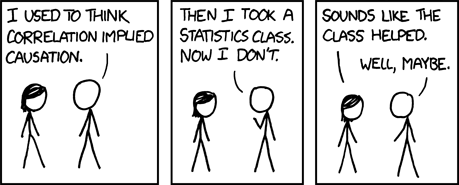
Two nearby events can but don't always mean that one caused the other.
If we were to spend more time in the Observation stage of our reading, and if we held back the urge to jump to the "obvious" conclusions, then we should also notice the following:
3. The devil did not immediately disappear after hearing the first scripture (O)
4. The devil did not eventually leave after the first instance of Jesus quoting the Scripture, either (O)
5. The devil still hadn't been driven off after the second scripture (O)
6. The devil himself knew and quoted the Scripture (O)
7. The devil quoted the Scripture, seemingly without harming himself (O)
8. Jesus (in Matthew's account) eventually added some other words to a third scripture (O)
9. Those words were "Away from me, Satan," by the way (O)
10. After the third Scripture quote, and (in Matthew) the command to leave, the devil left (O)
11. In Luke's gospel, the devil left—not "driven off by the scriptures," but when he "had finished all this tempting" (O)
12. In both accounts, the verb used is translated as "left" or "departed," rather than "fled" or "retreated."
So, when we try to interpret and apply this story, we have several questions to ponder. If scriptures have the power to drive away the devil, why did it take three tries? Wasn't the Scripture powerful enough? Wasn't Jesus powerful enough? Wasn't scripture in the mouth of Jesus powerful enough? And what does this mean for us?
Now, is the Bible important? And relevant when facing temptation? I believe so, from experience, and from Jesus' example. But is the Bible the devil's Kryptonite? I don't think the two versions of our gospel story support such a conclusion, and I'm wary of creating a doctrine out of a single episode in the Bible. Especially a doctrine that trivializes the Scriptures by reducing them to magical incantations and charms to ward off Satan or his minions. "The devil is a better theologian than any of us," A.W. Tozer cautions, "and is a devil still." He already knows the Bible—and in the original languages, I'll wager.
Could Jesus have defeated the devil without the Scripture? I would hope so. Are we powerless without Bible verses? Is that the source of all power we have? I would hope not. How about you?
September 21, 2009
The OIA Method of Studying the Bible
A simple but helpful technique that any of us can use has been called the OIA Method: Observe, Interpret, Apply. Studying the Bible this way is also referred to as "inductive," study because the goal is to read more like a detective, drawing careful conclusions from the particulars of a specific text, rather than making vague claims based on a mishmash of memories of various passages or simply rehearsing prior knowledge or opinion about the text at hand.
Step 2 (Interpret): Interpret your observations. What do they seem to mean or imply in the context?
Step 3 (Apply): Apply the interpretations to your own life or to the modern day.
A second strength of this method is that it helps us read a text more like a newcomer to the passage or to the faith would, to find common ground for discussion of scripture with those who are curious, and to see the obstacles to understanding that a particular
Much could be said about the details of the OIA method, but here are a handful of keys that I have benefitted from in my own study of the Bible.
Keys to Observation:
- Temporarily set aside previous understanding of the passage. Try to read with "fresh eyes."
- Make a list of everything you notice. Don't evaluate or filter your observations yet.
- Include what the passage does not say, in contrast to what it does say.
- Be patient. Don't jump to the "what this means" step.
- Record your questions. Questions don't mean failure. Far from it, when approaching an ancient text from another culture. They might just mean that you're now actually paying attention, finally able to see something that you never saw before.
- Note what surprises you, or what you expected to find.
- Fight the urge to trot out a familiar interpretation. Ask whether the observations actually lead you to such a conclusion.
- Be willing to wait for more evidence. Don't panic, thinking that you must know the meaning, or thinking that a real believer or a smarter reader would surely be able to figure everything out immediately.
- Ponder what your observations might have meant to the original audience in the original time, language, and culture. Obviously, this is difficult to know with certainty, but think about it. And consider becoming more educated on this critical topic.
- Ask why these facts were included in the passage and others weren't.
- Keep your focus tight. Don't jump around among
other passages that you think might be related, or that you have always heard discussed alongside this one. Be particularly careful of parallel passages in the gospels. Your immediate goal should be to understand what the author was driving at, not just to create harmonized timelines or similar distractions. Be willing to entertain interpretations that are novel, problematic, or even "heretical." These will energize your quest for better understanding.
- Realize that application doesn't have to be universal. "What does the passage mean to me?" is a valid question.
- Look for similarities between the characters in the passage and yourself.
- Ask how you are similar to the original audience and how you are different from them.
- Question the assumption of superiority for your modern context. Maybe this ancient text should speak to your life, too.
- Decide what points are still not clear to you, and move on to the next section of the book. Extended context often sheds more light.
- Pray for understanding, wisdom, and patience. Before, as, and after you read.
Frankly, much of this list applies to critical reading of any text and to reaping personal profit from reading—to being changed by it. And really, isn't that the point of worthwhile reading?
August 5, 2009
How Necessary Is the Bible?
There has never been a time in history at which we have all had the same Bible.
Ponder that one for a moment.
Setting aside that fact, consider that millions of believers both throughout history and today have lacked some or all of what Christians now call the Bible. The "New Testament church" did. The masses before the printing press (c. 1440). Much of the underground church still does. Many who have been imprisoned. Many who are poor, or blind, or infirm. Those who are illiterate. Those without a Bible in their own language (200 million people, at present). Those without a written language, even.
If the emphasis (or even overemphasis) placed on the written scriptures by some parts of the modern Christian church is correct, and if the near-legalistic expectation of "personal" Bible study—even if only for a trivial number of minutes or verses per day—is correct, then several questions come to mind regarding those who go and have gone without, those already in the prophesied "famine of the Word," as some might call it: What is their Christian life focused on? How are they to truly know God or hear his voice? And if faith comes by hearing, and hearing (by?) the word of God, then on what basis can they come to faith in the first place? Are they inevitably stunted in their spiritual growth, compared to those who have the complete Bible? Weaker brothers and sisters, to be pitied, perhaps?
It seems that we should conclude thusly.
And if we insist that any challenge a specific passage of scripture presents can be made sense of by "the whole Bible," and that the whole Bible is required for proper understanding of (any of? much of?) its contents, then what must we conclude about those without the whole Bible, now and throughout history? And those without any Bible? That these unfortunates are doomed to misinterpretation and misunderstanding on "all matters of faith and practice"? Even on essentials, such as ... the Trinity; the relationship between sin, faith, grace, and works; or the nature of their own relationship to God?
It seems that we should conclude thusly.
And what if our own favorite translation of the Bible contains mistakes? Or if, someday, we were to find the autographs (the original books of the Bible), written in the very hands of the original authors and/or scribes—depending on your view of how the Bible was written—and different from any of the manuscript witnesses (the later copies of the books), from which all of our various and varied translations have been made? Should we conclude that we have not had—have never had—the true "Word of God"? That nobody has ever had the correct Bible?
It seems that we should conclude thusly. That we the privileged, despite our feast of Bibles and Bible study tools, have actually been in a similar position to those who lived before the closing of the canon, or those behind the Iron Curtain, or those with no Bible in their own language. That we didn't have every answer at our fingertips. That we didn't have every last word. We should conclude that some of our opinions may have been misguided, some of our emphases misplaced. We should conclude that some of our knowledge, our certainty was actually error, or naivety. Or perhaps even arrogance.
It seems that we should conclude thusly. That we the privileged, despite our feast of Bibles and Bible study tools, have actually been in a similar position to those who lived before the closing of the canon, or those behind the Iron Curtain, or those with no Bible in their own language. That we didn't have every answer at our fingertips. That we didn't have every last word. We should conclude that some of our opinions may have been misguided, some of our emphases misplaced. We should conclude that some of our knowledge, our certainty was actually error, or naivety. Or perhaps even arrogance.
And what would this mean about God—if he has allowed all of us to wander in such imperfect light?
Or what would it mean about the Bible—if a perfect, loving, and holy God has not thought it necessary to provide one complete, uniform, and error-free Bible for all of us and for all of this time?
Despair not, gentle reader! More on this topic later.
Despair not, gentle reader! More on this topic later.
July 12, 2009
Harmonizing the Scriptures
Allow me to pause in our discussion of salvation to briefly consider an interpretation issue.
Many verses in the Bible seem to make no sense, or to be contrary to what we already believe is true, or -- worst of all -- to contradict what we thought the Bible said. Consider these examples, and how some might deal with the stickiness:
- The Old Testament God seems grumpy, if not downright steamed. On the other hand, New Testament Jesus seems loving. But Jesus is God, and God is the same "yesterday, today, and forever." So, God isn't actually an angry God.
- Creation took only six days. Fossils suggest that species popped out of the ooze over the course of millions of years. But "one day is with the Lord as a thousand years, and a thousand years as one day." So, creation actually took six thousand years -- and the fossils are wrong.
- Jesus said "Why do you call me good? No one is good except God alone." Therefore, Jesus is not equal to God, or Jesus doesn't realize that he is God incarnate. But Jesus also said "I and the Father are one." So, Jesus is actually equal to God -- and was probably just messing with the rich young ruler. Or it was a test.
We have a moment of doubt. We find another verse that dispels our doubt. We latch onto the second verse and ignore the first verse (or assign a new harmonized interpretation to it which may be totally contradictory to the actual words in the original verse). Verse 2 trumps verse 1. Problem solved.
We explain away the problems by "harmonizing" the scriptures, and this is seen by many as a reasonable practice -- or even the definition of "rightly dividing" the Bible, and thus evidence of one's own advanced skill. How is this different, however, from simply picking the verses that seem true to us and declaring that these ones have the correct meaning? How objective is our filter for sifting through the contradictions? Where does our filter -- our presuppositions -- come from?
The verses that already made sense to us? Circular reasoning.
What we were taught in Sunday School, or at mother's knee, or in seminary? Traditions of men.
What seems right in our own eyes? Ouch.
More on this another day.
June 5, 2009
How We Read the Bible
What happens when we read the Bible? How do we interpret what we read? In other words, how do we understand? Let's break down the process a bit and consider some theories about what might be happening:
First, our eyes look at the words--translated into our own language, of course. And then ...
Theories 1 - 3 are also contradicted by our experience of doctrinal arguments between different denominations. Universal understanding even by well-meaning clergy and laity is not what history reveals.
Theory 4 is harder to refute, since we don't know what voices people are hearing in their heads. Any argument against personal experience is difficult unless we can read minds. However, most honest people would admit to errors in their personal understanding of scripture, to thinking God had told them something but realizing later that it was fear, emotion, or their own desire to believe, and not the voice of God. This happens to even the brightest among us.
The perfect understanding held out to us in theory 5 would appear to be contradicted by the lack of agreement among scholars and experts.
Theories 6 and 7, then.... For us mere mortals, we appear to be left with incomplete understanding, and no certainty about how accurate we actually are when interpreting a given passage. And this uncertainty, this ambiguity is very threatening to some.
Interestingly, this is our condition even if we hold to the most extreme doctrines of Biblical inerrancy and infallibility. Every word may be the exact and perfect one, and perfectly true and authoritative, but this doesn't mean that we understand fully or that we all have the same understanding. Confidence in the Bible is different than confidence in my ability to fully grasp the thoughts of God after carefully reading it once--or a hundred times.
I love and believe the Bible. My argument here is not that the Bible is irrelevant or that we read it without hope of understanding. Rather, I see the need for patience and care when reading, for diligence to learn more about the language and context, for prayer that the Holy Spirit would aid in the understanding, and for humility when interpreting or when disagreeing with somebody's interpretation.
More importantly, I love and believe in the Lord himself--amazing mystery though he may always be to me. I believe that I can know him--as I am fully known. This is different from knowing about him through reading the Bible. I can know information in a book, or a book itself, but those will always be qualitatively different from knowing a Person. As in other relationships, perfect knowledge and perfect understanding on my part are not requirements or priorities. We know in part, and ultimately, knowledge will pass away.
First, our eyes look at the words--translated into our own language, of course. And then ...
- We understand the exact meaning intended, because that's what always and automatically happens when we read.
- We understand the exact meaning intended, because of good intentions and careful concentration.
- We understand, because of a miracle, the one exact meaning ever and always intended.
- We understand, because of a miracle, the unique meaning that God wants us to have at that moment.
- We understand something, based on our understanding (= our interpretation) of what the words mean to us in our own culture and time, but the meaning may be different from what was originally intended by the author--or the translator--or what was originally understood by the original audience of native speakers from those cultures 2,000 - 5,000 years ago. Therefore, only the history scholars and language experts among us can aspire to perfect understanding.
- Even if we are scholars and experts, what we understand is filtered through our own personal experience (as per Rosenblatt's transactional theory of reading), and will change as our experience changes. Our understanding of verses about God as father, for example, is affected by our own experiences with our own fathers and our experiences with or without children of our own.
- We understand something, but not necessarily the complete and perfect, higher-than-our thoughts of a supernatural, eternal, and omniscient God.
Theories 1 - 3 are also contradicted by our experience of doctrinal arguments between different denominations. Universal understanding even by well-meaning clergy and laity is not what history reveals.
Theory 4 is harder to refute, since we don't know what voices people are hearing in their heads. Any argument against personal experience is difficult unless we can read minds. However, most honest people would admit to errors in their personal understanding of scripture, to thinking God had told them something but realizing later that it was fear, emotion, or their own desire to believe, and not the voice of God. This happens to even the brightest among us.
The perfect understanding held out to us in theory 5 would appear to be contradicted by the lack of agreement among scholars and experts.
Theories 6 and 7, then.... For us mere mortals, we appear to be left with incomplete understanding, and no certainty about how accurate we actually are when interpreting a given passage. And this uncertainty, this ambiguity is very threatening to some.
Interestingly, this is our condition even if we hold to the most extreme doctrines of Biblical inerrancy and infallibility. Every word may be the exact and perfect one, and perfectly true and authoritative, but this doesn't mean that we understand fully or that we all have the same understanding. Confidence in the Bible is different than confidence in my ability to fully grasp the thoughts of God after carefully reading it once--or a hundred times.
I love and believe the Bible. My argument here is not that the Bible is irrelevant or that we read it without hope of understanding. Rather, I see the need for patience and care when reading, for diligence to learn more about the language and context, for prayer that the Holy Spirit would aid in the understanding, and for humility when interpreting or when disagreeing with somebody's interpretation.
More importantly, I love and believe in the Lord himself--amazing mystery though he may always be to me. I believe that I can know him--as I am fully known. This is different from knowing about him through reading the Bible. I can know information in a book, or a book itself, but those will always be qualitatively different from knowing a Person. As in other relationships, perfect knowledge and perfect understanding on my part are not requirements or priorities. We know in part, and ultimately, knowledge will pass away.
Subscribe to:
Posts (Atom)


 Posts